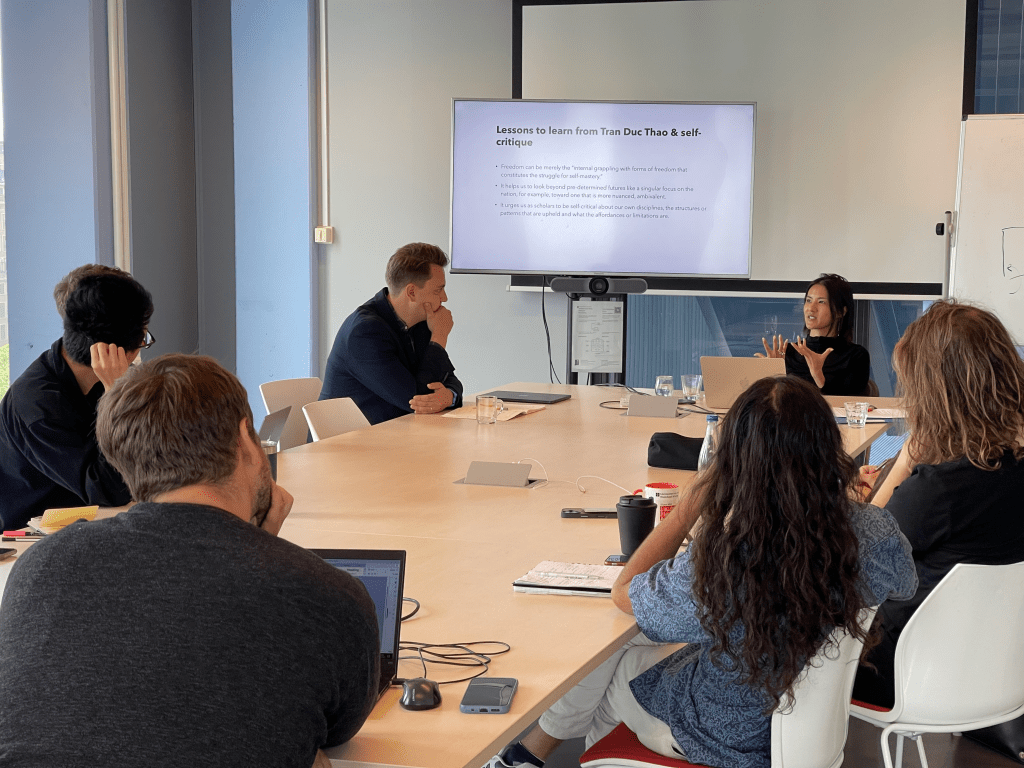
This summer I am in Amsterdam for a residency with the Decolonial Futures RPA. I presented a masterclass to a group of political theorists (a first for me!) in which I discuss the self-criticism (both the political practice and the philosophical method) of Vietnamese philosopher Tran Duc Thao and how he fits into the larger framework of my manuscript Language as form.
Why write in a language that is not one’s own? Can doing so be a decolonial act?
This masterclass returns to a fundamental question of freedom and expression in language, notably in a colonizer’s language. Drawing on scholarship on Vietnamese intellectuals writing in French in the 20th century, Yen Vu proposes to read such writing as a choice in form. Rather than engaging with why these writers write in a language that is not their own, which have preoccupied the conversations in both Postcolonial Studies and Vietnam Studies, she asks what happens when one writes in French. What emerges, or to what effect, does writing in French afford the Vietnamese?
This conceptual shift toward formal analysis allows us to demystify the various forms and shapes that freedom has taken in Vietnam, whether anticolonial, nationalist, anticommunist or even anti-Confucianist. We will examine in particular how reading language as form elucidates the thought of Marxist philosopher Tran Duc Thao and his self-criticism – as a political practice and a philosophical method. Writing in French thus did not need to render some clear outcome or participate in nationalist projects. Instead, we can consider the alternative possibilities of writing in French, such as how writing in French allowed these intellectuals to contemplate a world and existence beyond their immediate circumstances, to conceive of decolonization in ways beyond mere relations of power, or to engage in philosophical questions about form and content.
 yen n. vu